
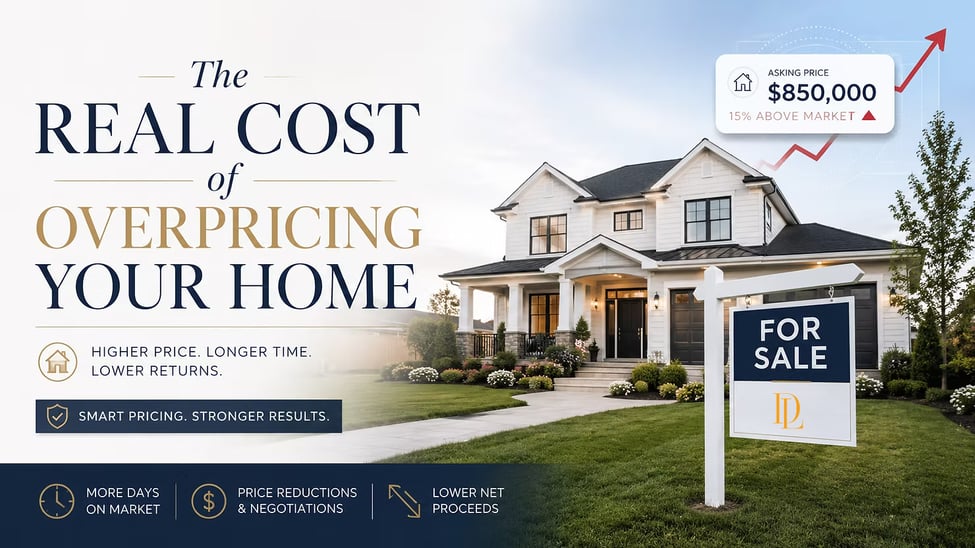
Every seller wants top dollar. That's completely reasonable. Your home might be your biggest asset, filled with years of memories, upgrades, and hard work. So when it's time to list, the temptation to "start high and see what happens" makes sense on the surface.
But here in Durham Region, I've watched this strategy backfire more times than I can count. Overpricing doesn't just cost you time. It can cost you momentum, buyer interest, negotiating power, and ultimately, money.
Let's talk about why.
Buyers Know More Than Ever
Gone are the days when buyers relied entirely on their agent to tell them what a home was worth. Today's buyers are comparing your listing to every other home online in real time. They're tracking price reductions, days on market, condition, upgrades, and recent sales in the neighbourhood.
If your home is priced above what the data supports, buyers notice quickly. And here's the part most sellers don't expect: overpriced homes rarely generate lower offers. They generate silence. Buyers simply scroll past.
The First 10 Days Set the Tone
When your home hits the market, it gets the most eyes on it that it will ever get. Serious buyers in Whitby, Ajax, Oshawa, and Bowmanville have alerts set up. Their agents are watching too. That early window is your best shot at creating real momentum.
If the price is off from day one, those same buyers look once, shake their heads, and move on. A price adjustment later rarely recreates that original excitement. You typically only get one first impression on the open market.
An Overpriced Home Can Make a Great Home Look Bad
This is the part that stings. A beautiful, well-maintained home in a fantastic location can still get overlooked if the price doesn't match the comparables. Buyers start asking:
"Why is this so much higher than everything else we've seen?"
"Is the seller being unrealistic?"
"Will they even negotiate?"
Instead of falling in love with your home, buyers start questioning it. That's not the reaction you want.
Days on Market Change How Buyers Think
A brand new listing creates urgency. Buyers think, "if we want this, we need to move." But once a home sits for weeks, the psychology flips. Buyers start wondering what's wrong with it, whether other buyers already passed, and how low they can offer.
Even when nothing is actually wrong with the home, time on market creates doubt, and doubt weakens your negotiating position.
Price Reductions Can Signal Weakness
A strategic adjustment based on real market feedback is normal. But repeated or late reductions send a different message: that the seller might keep coming down. Instead of urgency, buyers sense a struggling listing, and that often leads to lower offers and tougher negotiations.
Your Overpriced Home Might Be Helping Your Competition
Here's something sellers rarely consider. When your home is priced too high, it can make a similar home down the street look like the better deal by comparison. Buyers are comparing side by side, and your overpriced listing might be the reason someone chooses another property entirely.
The Market Doesn't Price Based on What You Need
This is a hard truth, but an honest one. Sellers often have a number in mind tied to their mortgage payoff, moving costs, next purchase, or what a neighbour sold for. Those goals matter to you, and they should. But buyers don't price a home based on what a seller needs to walk away with. They price it based on comparable homes and what else is available right now.
The job of a strong pricing strategy is connecting your goals with what the market will actually support, not ignoring one for the other.
Online Estimates Aren't a Pricing Strategy
Automated home value tools can be a helpful starting point, but they don't account for condition, layout, upgrades, lot quality, or how your home compares to active competition today. A number on a screen isn't the same as what a real buyer, in this market, right now, is willing to pay.
The Market Always Tells the Truth
Showing activity tells you almost everything. Few showings and little online engagement usually means the price and buyer expectations don't match. Showings with no offers points to something else, whether it's presentation, condition, or positioning. Strong traffic with no serious interest often means you're close, but not quite there.
Ignoring that feedback is often the most expensive mistake a seller can make.
The Bottom Line: Overpricing Can Lead to a Lower Final Sale Price
This is the outcome sellers want to avoid most, and unfortunately, it's the one I see happen the most. By the time the price becomes realistic, momentum is gone, buyers have moved on, and new competition may have entered the market. In many cases, the eventual sale price ends up lower than what a strategic launch price would have achieved from day one.
Pricing high doesn't always protect your negotiation room either. Buyers can't negotiate on a home they never walked through, and if the price feels off, many of them never book the showing in the first place.
Pricing Right Isn't Pricing Low
Let me be clear about something. Strategic pricing doesn't mean giving your home away or leaving money on the table. It means understanding exactly where your home fits in today's Durham Region market and positioning it to attract the strongest possible buyer response.
This is exactly why I built the Signature Seller System™. It starts with strategic pre-marketing and real pricing validation, backed by comparable sales, current competition, buyer demand, and days on market trends, so your home launches with a plan instead of a guess. From there, controlled exposure and a structured 3-phase marketing approach keep buyer psychology working in your favour instead of against you.
My Honest Take
Every seller deserves top dollar. But top dollar comes from strategy, not from wishful pricing. The strongest results happen when a home is prepared well, presented professionally, priced accurately, and launched with intention.
The real cost of overpricing isn't just extra weeks on the market. It's lost momentum, weaker buyer interest, more price reductions, and sometimes a lower final sale price than you would have earned by pricing it right from the start.
The better question isn't "what's the highest number we can try?" It's "what price gives us the strongest chance at the best possible outcome?"
If you're thinking about selling anywhere in Durham Region, let's have that honest conversation before you list. No pressure. Just real numbers, honest feedback, and a strategy that actually makes sense for your goals.